Monastic Life
- Saint Benedict and the Rule of the Monks -
The desire to leave everything so as to enter monastic life is a mystery. Why such a choice, or rather for whom? The call to such a life, of which Christ himself gave the example by his hidden life, his stay in the desert, his solitary prayers, and especially his cross, is not something new.
By their baptism, all Christians are called to foster the love of God within themselves. This perfection can be achieved by living in the world, but there is also another way, more direct and steeper, which was at first that of martyrdom. Then, when the persecutions ceased, some particularly fervent Christians, who still had the desire to give their lives for Christ, went into the desert to lead a very radical life of asceticism and prayer. Some of them gathered themselves in small communities, and thus monastic life was born. In the sixth century, St. Benedict, who had first led a similar life in solitude, gathered around himself disciples and wrote for them a rule of life, prescribing them to live as a family of brothers, gathered under the loving authority of a father to seek God, to devote themselves to singing His praise in the choir and to manual work, taking care never to prefer nothing to the love of Christ.

Through baptism, all Christians are called to grow in the love of God. This perfection can be achieved by living in the world, but there is also another way, more direct and steeper, which was first that of martyrdom; then, when the persecutions ceased, some particularly fervent Christians, who still desired to give their lives for Christ, went to the desert to lead a very radical life of asceticism and prayer.

This Rule spread throughout the Christian West over the following centuries. Through the wisdom of its provisions, it deeply influenced the construction of the Christian social order that we have inherited. But beyond a treasure of human wisdom that continues to amaze and inspire our contemporaries today, it is above all a path to God, in the spirit of the Gospel, for all those who “hasten their steps toward the heavenly Homeland.”
- Monastic Vows -

He who commits himself by vows to observe the evangelical counsels, in a total offering of his life, finds true freedom of heart by becoming available for God alone (cf. Mt 19:21 “if you would be perfect, go, sell what you possess and give to the poor, and you will have treasure in heaven; and come, follow me”).
In his Rule, Saint Benedict has the monk pronounce a triple promise: that of living stability, conversion of life, and obedience.
Stability
Among the different forms of religious life, monastic life presents a very specific framework, of which the enclosure is the most manifest element. By the vow of stability, the monk commits to remaining all his life in the same community, normally the one where he made his profession. Physical stability is there to favor the soul’s withdrawal from all the tumult of the world. The vow of stability is subordinate to that of obedience, so that the monk may be sent to a new foundation, or to help in another monastery.

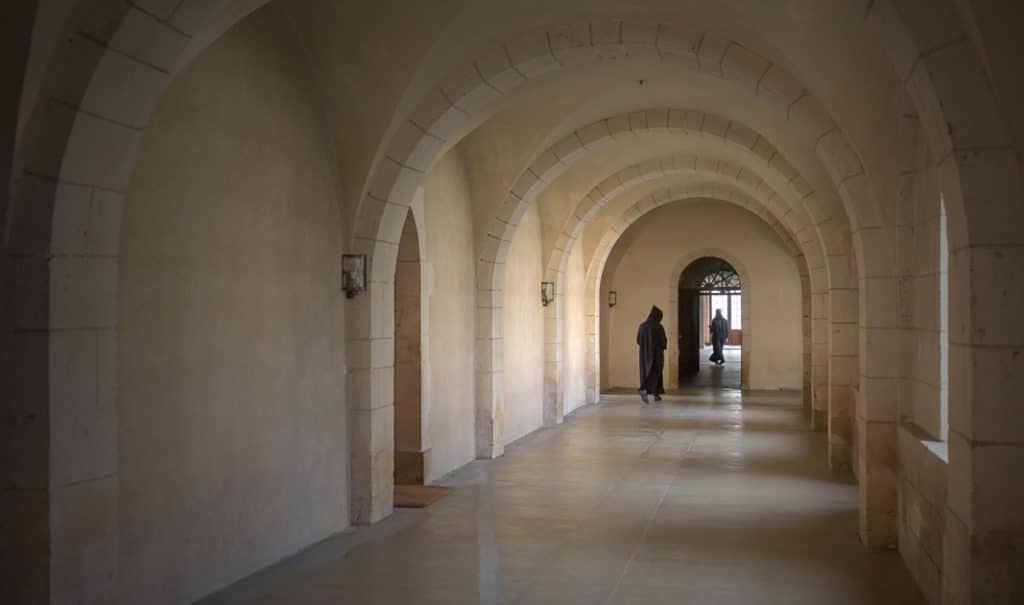
One of the consequences of this vow of stability is the concern for the beauty of the place where the monks live, with a view to the inner blossoming of souls. Conscious of this influence of the exterior on the interior, monastic tradition has always carefully chosen the sites where abbeys were established. If he must leave the enclosure of the monastery for any business, the monk asks for the permission and blessing of the superior. Indeed, Saint Benedict specifies that it is in the monastery, compared to a workshop, that the monk must use the “tools of good works” described in chapter 4 of the Holy Rule, if he wishes to reach the desired goal.

In a world of extreme mobility and permanent instability, the monastic enclosure serves as a reminder of the values of rootedness. By renouncing external changes, the monk can rediscover the joy of living at the rhythm of the seasons, weaving over the years that connivance with nature that farmers faithful to their land know well. Then the enclosure is no longer a prison, but the means to rediscover the primary destination of all creation, which is to sing the glory of God.
Separated from men, the monk finds them more deeply in God; he gathers their secret distresses and calls down divine mercy upon them.
Conversion of Life
— abc

Through poverty, the monk renounces all that is fleeting, in order to be rich in God Himself. Monastic poverty requires the monk to possess nothing of his own; what he uses daily is simply for his use, belonging to the monastery. He submits to the judgment of the Abbot, simply asking for what is necessary. Thus, he keeps his soul free to be attached to God alone. All that is necessary for the life of the community and its activities (vast buildings, lands, workshops, numerous tools, etc.) has no other owner or purpose than God Himself.

Monastic chastity does not only correspond to the fact of renouncing founding a family and living in sexual abstinence; it is a firm purpose to do one’s best not to give one’s heart and affections to anyone or anything other than God himself, that is to say, to love everything in God and for the sake of God. Chastity is an expansion of man’s capacity for love. “Chastity for the sake of the kingdom of heaven (Mt 19:12), which religious profess, must be regarded as a great gift of grace. It singularly frees the heart of man (1 Cor 7:32-35) so that he may burn with love for God and for all men; that is why it is a special sign of heavenly goods, as well as a very effective means for religious to consecrate themselves unreservedly to divine service and to the works of the apostolate. They thus evoke before the eyes of all the faithful that admirable union established by God and which must be fully manifested in the future age, by which the Church has Christ as her unique spouse.” (Second Vatican Council, decree Perfectae Caritatis §12)
Obedience

Through obedience, the monk submits his will to God, thus renouncing directing his own life to let himself be guided by those whom God has placed on his path to speak to him in His Name: “whoever listens to you listens to me” (Lk 10:16). With the vow of obedience, the monk renounces what is most intimate to him: his own will. This renunciation is often the one that most scandalizes our contemporaries: is not freedom the first good of man, which he cannot alienate without falling? In fact, obedience does not consist in renouncing one’s freedom, but rather everything that hinders the full use of that freedom, that is to say, what prevents one from always choosing with all one’s soul the most desirable good, the only one that will never pass away, namely the will of God.
Obedience is based on faith: it is in faith that the monk recognizes the will of God in the order of his superiors and that he enters into the great movement of obedience that draws all creation toward the Father. Obedience is also and above all a matter of love: it is out of love for God, out of a desire to imitate Christ obedient unto death on the Cross, that the monk accepts to renounce his own will. Saint Benedict even recommends that monks obey one another, so great is the benefit derived from it.
- Monastic Virtues -
Humility

For Saint Benedict, humility is a fundamental attitude of the soul, which is also manifested through obedience.
It heals the deepest wound created in us by sin, this tendency toward exaltation and self-sufficiency, toward the selfish affirmation of the ego.
The path to rediscovering our true place before God and before men is marked by Saint Benedict with twelve degrees of humility, with their internal components and their resonance in the external attitude (Rule, ch. 7).
Silence

Silence is another great characteristic of the monks’ particular way of life. Each of them is called to free himself from useless chatter to let the Word of God grow in the depths of his soul.
Thus Saint Benedict is very strict on this point in his Rule: even to disciples already formed, he does not want permission to speak to be granted too easily. A special place is reserved for night silence, from the end of Compline until the office of Prime the next morning: in unison with nature, the monks are then invited to observe absolute silence. During the course of the day, it is possible to speak for reasons of work or charity, but with moderation and discretion.

A moment of relaxation is provided each day, generally after lunch, where the monks can converse freely. These recreations offer an opportunity to share the humble events of the community’s life, as well as news of the life of the Church and the world. Once a week, a walk of about three hours gives bodies and souls the opportunity to relax and recreate each other in joy and fraternal charity.
- The Life of Prayer -

Prayer is the fabric of which the monk’s entire day is woven, throughout his life. Thus Saint Benedict asks above all, when a candidate for monastic life presents himself, to check “if he truly seeks God” (Rule, ch. 58), for the search for God, which is like the definition of monastic life, is realized mainly through prayer.
To pray is to remain with God, to love him in a gaze that no longer needs words and which is only an expectation of the final encounter. This very sweet inner prayer is reconciled throughout the day with many activities, but the monk must also devote exclusive moments to this encounter with God, time consecrated to Him alone.
The Liturgy

The monk is first and foremost a man of the liturgy, the official prayer of the Church offered unceasingly to God on behalf of all humanity. Saint Benedict invites the monk to prefer nothing to this primary work. Gregorian chant, the proper chant of the Latin Church, whose beauty and power of spiritual evocation transcend all eras, invites souls to enter gently into the mystery. The solemnity surrounding the Conventual Mass makes one realize that the Eucharist is truly, in the words of the Second Vatican Council, “the center and summit of the life of the Church and of every Christian.”

At Fontgombault, we celebrate with the authorization of the Holy See the traditional liturgy, whose centuries-old rites, delicate fruits of the virtue of religion, wonderfully help the soul to enter into a climate of adoration before the divine majesty. At the end of Lauds, the priest-monks each celebrate Mass in great recollection; concelebration is reserved for certain feast days.

From this center that is the daily Eucharistic sacrifice, radiate the different Hours of the choral office, which sanctify the various moments of man’s day, offering for them all to God, in the name of Mother Church, a homage of praise and adoration, a prayer of petition and reparation, through the words of the psalms, where all the expectations and feelings of the human soul are expressed in an inspired poetic language. By returning to the choir seven times a day and once at night, the monks manifest that time belongs to God and is consecrated to him. The one hundred and fifty psalms are distributed over the week according to the arrangement proposed by Saint Benedict in his Rule.

The service of praise begins, between 4:40 and 5:15 AM depending on the solemnity of the office, with Matins, which always include twelve psalms. They are followed by Lauds, which bear this name because they always contain the last three songs of the psalter, dedicated to praise.
The other Hours correspond to the division of time among the ancients: Prime, Terce, Sext, and None are respectively the first, third, sixth, and ninth hours of the day. Since the 9th century, Prime has included, after the office described by the Rule, a small office in the chapter house, with the reading in the Martyrology of the list of all the saints and blessed celebrated the next day, as well as prayers for the deceased (monks, friends and benefactors, people recommended to us), and the reading of a chapter of the Holy Rule.

The office of Terce is celebrated at 10:00 AM, followed by the sung Mass. Sext and None take place respectively before and after the meal and recreation; the office of Vespers, more solemn, takes place after the afternoon work, and that of Compline, preceded by a reading in the chapter house, ends the monk’s day.
Personal Prayer

In addition to liturgical prayer, which occupies at least four hours of his day, the monk is invited to seek God in the heart-to-heart of silent prayer, a moment of intimacy with the One by whom he knows he is loved. Each also prays the Rosary daily, in whole or in part, as the faithful homage due to the Virgin Mary, Mother of all monks and Queen of these places.
Sacred reading or lectio divina is another form of monastic prayer, nourished primarily by Holy Scripture, the Fathers of the Church, and spiritual authors. This meditative reading blossoms spontaneously into prayer of the soul.
- Community Life -
The Abbot
Monastic life takes place within a community that Saint Benedict has provided with a Father, which is what the word “Abbot” means. It is to him that the obedience requested of all first goes; it is to him that a very delicate filial love must also go, which comes from the fact that faith designates him in the eyes of the monks as holding the place of Christ.
He is elected for life by the monks, which allows his influence to leave a lasting mark on the community and ensures the stability that souls need to seek God.

The Abbot is responsible for giving souls spiritual doctrine, for encouraging and guiding each one on the path of perfection, through his exhortations, but also if necessary through reprimands and corrections. Saint Benedict did not hide from him the difficulty of his task: “the Abbot must always remember the name he bears, and know that more will be required of him to whom more has been entrusted. Let him also know how difficult and arduous is the task he assumes of leading souls and of adapting to multiple characters” (Rule, ch. 2). He insistently reminds him that he will have to give an account to God for his management, that he must seek “to serve even more than to command,” and “to be loved rather than feared.” He must “put mercy before justice,” but without departing from a gentle firmness that will make him “hate vices while loving the brothers” (Rule, ch. 64).
For young monks coming from a society marked by the absence of the father figure, a true re-education of the heart is sometimes necessary to enter into the joy of filial trust toward the Abbot, whose fatherhood then appears as the sacrament of divine fatherhood.
The Community
Sons of the same father, the monks are invited to develop fraternal charity among themselves. This does not exist without each one taking care to concretely reduce the demands of his selfishness and to put himself at the service of all.
A true fraternal life in community requires that each one renounce himself a little, what interests him or would highlight him, to cultivate the family spirit, the sharing of joys and sorrows, fraternal mutual aid, and the concern for the unity of hearts and minds.
The Lay Brothers
At Fontgombault, the unique monastic vocation is realized in the distinction between choir monks and lay brothers. Very ancient in monastic history, this distinction was confirmed by the Second Vatican Council (decree Perfectae Caritatis §15). Called to the same ideal of monastic life and holiness according to the Rule of Saint Benedict, but without confusion of vocations, both pronounce the same vows and wear the same habit.
The vocation of Lay Brother is addressed to young men, whether already engaged in professional life or not, who feel called to seek holiness in the offering to God of the work of their hands. The life of the Brothers is characterized by service. Their daily schedule allows more time for manual labor.
Thanks to the many indispensable tasks they can thus perform, they allow the choir monks to devote themselves at length to the divine office, leading themselves a humble and hidden life, whose model is the figure of Saint Joseph at Nazareth.


The Novitiate
In the monastic family, the novitiate forms a distinct group. The novices share in the prayer and work of the entire community, which surrounds them with discreet affection, but their formation is solely the responsibility of the Master of Novices, under the authority of the Abbot.
One who believes himself called by God to become a monk is first invited to stay for a certain period at the guesthouse. If he perseveres in his intention to enter the monastery and the Abbot accepts him, he may enter the novitiate. The first commitment is made for three years and cannot take place before at least two years spent among the novices. After his first vows, the young monk remains for two more years in the novitiate group to complete his initial formation.
There is no absolute rule concerning the age at which one can enter the novitiate, but the formation provided there is adapted for young men from about 20 to 35 years old.
- Work -
Manual Labor


Work is an essential component of human life, always assumed by monks as a collaboration with the action of the Creator (Gen 2:15: “The Lord took the man he had formed and placed him in the garden to work it and keep it”) as well as in a spirit of penance, in the logic of Redemption (Gen 3:19: “By the sweat of your brow you shall eat your bread,” God said to man after sin). Through manual labor, the monk consecrates his physical strength to the service of God while maintaining the spirit of prayer. “Let each of them, in his task, feel bound by the common law of work and, while thus providing what is necessary for their maintenance and their works, let them reject all excessive concern and trust in the providence of the heavenly Father (Mt 6:25)” (Perfectae Caritatis, §13).

All work to ensure the subsistence of the community. First, there are the tasks required by daily life: cooking, laundry, maintenance of the house and gardens. It is also necessary to produce vegetables and fruits,
…… as well as dairy products, eggs, and meat, all productions of which the surplus is sold outside.
A small vineyard is sufficient for the community’s table consumption, as well as for the celebration of daily Masses.


Certain workshops have an artistic production intended for sale, such as pottery, the icon workshop, or the one for enamels made in the spirit of the 12th century Limousin workshops. Several other workshops are intended for the work necessary for the maintenance of the monastery: plumbing, electricity, building maintenance, painting and glazing, carpentry…

It is from this carpentry workshop that, among other things, the great organ of the abbey church came, designed according to the principles established by a 17th-century Benedictine, Dom Bedos de Celles, and inaugurated in 1994, after ten years of work in collaboration with an organ builder, Mr. Jouve. The instrument includes forty-five stops, four keyboards, and more than three thousand pipes; its voicing was entirely redone by Franck Bistocchi in 2012. A printing workshop produces leaflets, booklets, and works for the use of the community and guests, as well as certain publications intended for sale.

The old mill on the Creuse has been equipped since 1980 for the production of hydroelectricity. The installation was entirely renovated in 2020 and equipped with new technology.
Welcoming Guests
In accordance with the precept of Saint Benedict, the community strives to welcome every newcomer as Christ.
The porter’s lodge is the small building where all newcomers knock: guests, visitors, delivery men, simple tourists, families of the monks. It also serves as a religious bookstore and offers various objects of piety.

In accordance with the precept of Saint Benedict, the community strives to welcome every newcomer as Christ.
The guesthouse, integrated into the monastic buildings for men, and outside the monastery for women and families, receives the families of the monks, as well as all individuals and groups who ask to spend a few days of spiritual renewal.
Formation
Finally, a certain number of monks devote time to the formation of novices and young monks studying philosophy and theology.