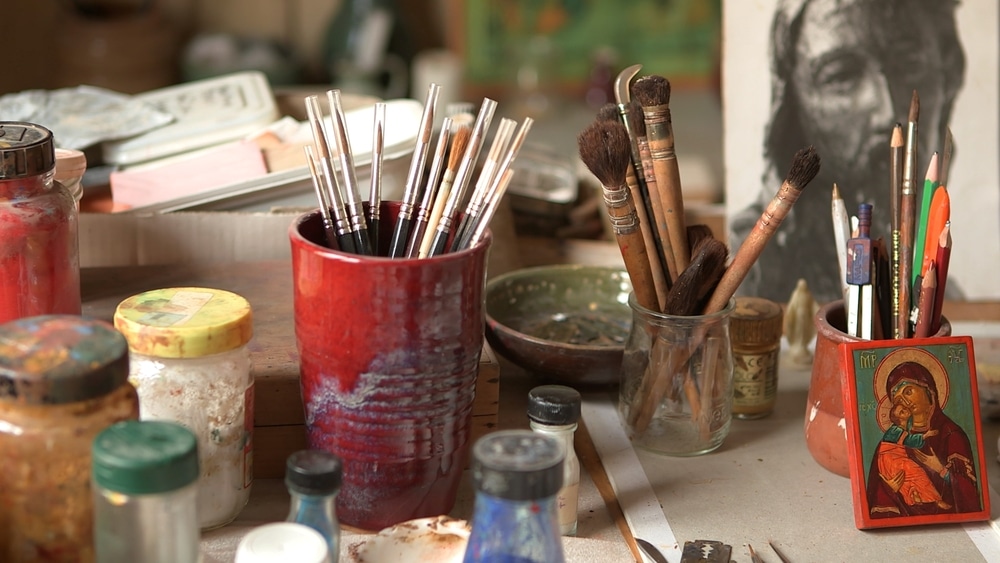
The term “icon” derives from the Greek eikon, which means “image.” This word is commonly used to designate a painting, often portable, with a religious subject, executed on a wooden panel, according to a particular technique and based on a tradition transmitted from century to century and still alive.
 Christian iconography, which finds its origins in the catacomb frescoes of the 2nd, 3rd, and 4th centuries, has Byzantium as its homeland. From there, this art spread to Slavic countries starting in the 10th century, also exerting a notable influence on the Latin West. Certain Romanesque frescoes up to approximately the 12th century are very close to Eastern iconography. The triptych presented here is a recent creation in this style.
The difference between an icon and a simple painting is that the icon must direct the viewer to the object. The gaze does not stop at the image; the icon immediately refers to the object we are meant to contemplate: the resurrected, transfigured Christ, the Virgin Mary… whereas paintings by great artists tend to hold the gaze on themselves. An icon painted by someone who has truly contemplated is never the object of the gaze, which then spontaneously passes beyond it.
 The Second Council of Nicaea solemnly defined in 787, in the face of the iconoclastic movement, the theological foundations and legitimacy of Christian iconography and the veneration of images. The council taught that it is permissible to represent Christ, true God and true man, because while remaining the invisible God, the eternal Word, consubstantial with the Father, the second Person of the Holy Trinity, He became visible to our eyes by incarnating and assuming a human nature. To refuse the icon would therefore, the Fathers affirmed, be to deny the incarnation of the Word of God. The icon of Jesus Christ is the expression, through an image, of the doctrine of the Council of Chalcedon (451), for it represents neither the divine nature alone, which is invisible, nor the human nature of Christ alone, but the divine Person of the Son who unites in Himself “without confusion or change” these two natures. The icon of Christ is therefore a “theandric” image, meaning partly celestial and partly human. “The iconography of Christ,” wrote Saint John Paul II in the apostolic letter Duodecim saeculum, thus engages the entire faith in the reality of the Incarnation and its inexhaustible significance for the Church and for the world. If the Church practices it, it is because she is convinced that the God revealed in Jesus Christ has truly redeemed and sanctified flesh and the entire sensible world, that is, man with his five senses, to allow him ‘to be renewed constantly in the image of his Creator’ (Col 3:10).”

 According to Saint John Damascene (8th century), the icon is a “channel of grace, with sanctifying virtue.” Indeed, after being blessed, the icon becomes a sacramental, that is, a sign of grace, not in the manner of sacraments which are effective by virtue of their institution by Christ, but by virtue of the powers and prayer of the Church. Consequently, the icon is an aid for the spiritual life of the Christian. By representing Jesus Christ, the Mother of God, the Angels, scenes from the life of Christ, the Virgin, or the Saints, the icon mysteriously renders them present in a way. This presence is not attached to the colored wooden panel, but to the “resemblance with the prototype,” that is, with the person represented on the icon; a resemblance that the Church undertakes to authenticate before blessing the icon.
Eastern tradition calls the icon “mirror of invisible beauty” and “window open to eternity.” Viewed with the eyes of the heart and in the light of faith, the icon opens to the world of the spirit, to invisible realities and uncreated Beauty, to the Christian mystery in its supra-terrestrial reality. It is like a “visual theology.”

 The iconographer is bound to respect the traditional “canons” (i.e., rules) of this art, which the Eastern Church established in detail over the centuries. These prescriptions aim to guarantee the conformity of the painting with the entirety of the Church’s experience of Christ, as expressed in Scripture, liturgy, and theology. The pictorial style of the icon does not aim to reproduce or perfectly imitate nature, but to create an image transfigured by the spiritual radiance of the mystery. The icon is not a portrait, but the prototype of future humanity, freed from passions, from all sensual aspects, from the laws of matter, time, and space, and transfigured in glory. Movement itself is reduced, hence the hieraticism so characteristic of Eastern iconography, suited to providing a supra-terrestrial vision of the sensible world.
The iconographer is not to sign their work, for it belongs to the Church. The artist, especially if a monk, as is traditional in the East, steps aside before the tradition that speaks.
