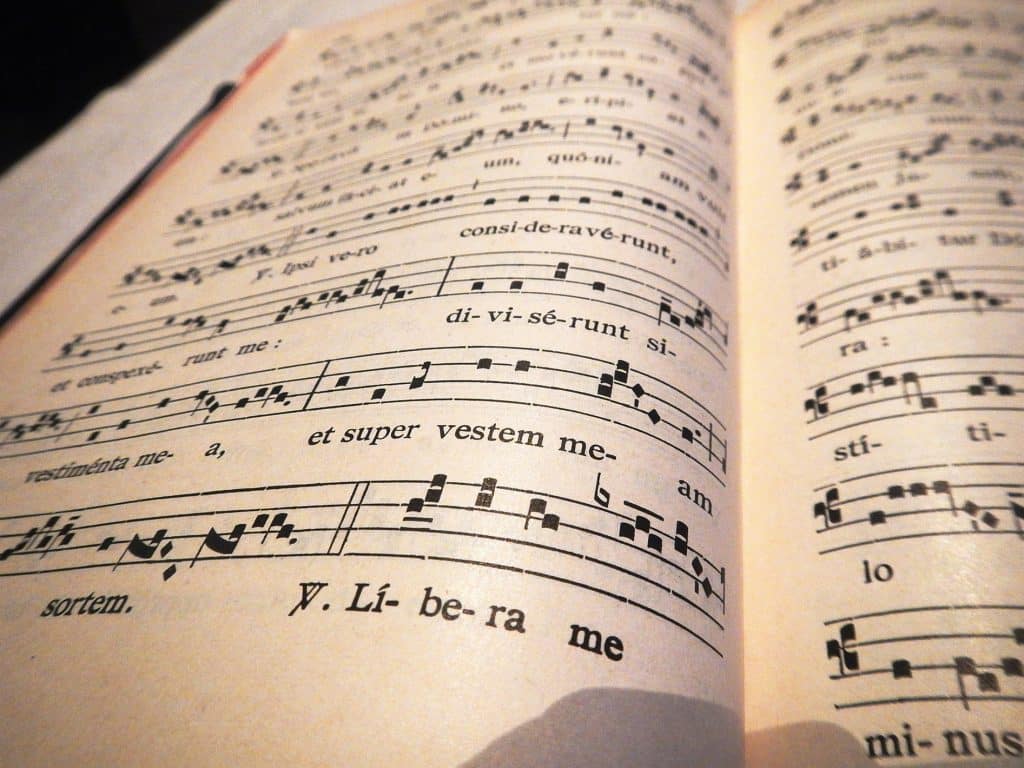
Interpretation
Gregorian chant eminently possesses the three characteristic notes of sacred music: holiness, universality, and beauty. This chant is directly and solely at the service of prayer; this is why the Constitution on the Liturgy of the Second Vatican Council declares:
The Church acknowledges Gregorian chant as the chant proper to the Roman liturgy; therefore, other things being equal, it should be given pride of place in liturgical services.
(Sacrosanctum Concilium, § 116)
Although Gregorian chant generates genuine scientific and cultural interest, its primary reason for being is liturgical. However, today there are very different ways of practicing Gregorian chant. To understand this, it is necessary to first briefly review its history, before explaining the reasons why the monks of Fontgombault, in their interpretation, chose to remain faithful to the heritage received from Solesmes in 1948.
- History of Gregorian Chant -
The Origins
The origins of Gregorian chant are complex and largely obscure. The first Christians naturally inherited the rites, texts, and melodies of their original environment. Primitive liturgical chant was simple in form: psalmody, acclamations, and improvised prayers by the celebrant based on defined schemas. The spread of Christian worship in countries of diverse languages around the Mediterranean basin gave rise to various Eastern rites: Armenian, Chaldean, Syro-Malabar, Maronite, Coptic, etc. In the Churches of the West, while each region had its own repertoire for chant, Latin gradually established itself as the liturgical language during the 4th century.
Gregorian chant was built upon Latin accentuation: after the stage of simple vocal impulse on the accent to emphasize the word, the text was melodically punctuated at accents and endings, as is still the case in psalmody and the verses sung at Lauds and Vespers. The influence of Jewish and Greek traditions is more evident in the modality of these melodies. After the Edict of Milan ended the persecutions (313) and the first basilicas were built, the chant expanded at the pace of the liturgy: for example, the processional entry of the bishop and clergy was accompanied by an antiphon alternated with psalm verses, which we still call an introit today.
The Development of Compositions
Between the 5th and 8th centuries, sacred chant experienced a period of composition and repertoire fixation; it was increasingly entrusted to the schola cantorum, a group of specialized clerics capable of performing increasingly elaborate pieces.
The golden age of Gregorian chant was between the 8th and 10th centuries. Thanks to a political rapprochement between the papacy and the Frankish kingdoms, Roman liturgical practices were adopted by Pepin the Short for his kingdom. These events were decisive for the evolution of liturgical chant. Bishops of Gaul, such as Saint Chrodegang of Metz and Remedius of Rouen, requested books and cantors from Rome. Indeed, sacred chant was not yet notated, the melodies being entrusted to the memory of the cantors. Charlemagne continued this work, and his zeal for liturgical unity would decisively mark the evolution of the Roman liturgy.
Upon receiving the texts of the Roman liturgy, Charlemagne’s cantors had to adapt or recompose melodies, giving birth to the “Carolingian” repertoire that would spread throughout Europe. The organization of this work by Saint Gregory the Great (+604), who enjoyed considerable popularity throughout the Middle Ages, earned it the current name of “Gregorian chant.”
These developments were accompanied by the invention of a system for writing melodies, a major event in the history of music. From the 9th century, the first “notated” chant manuscripts appeared. These manuscripts were initially adiastematic, meaning they did not indicate intervals. The melodic signs (called neumes, from the Greek pneuma, breath) only suggested pitches, which were known by heart. They were highly precise regarding rhythm and movement. With the writing of melodies, the theorization of music also developed. Manuscripts indicating intervals would appear at the end of the 11th century; but paradoxically, rhythmic precision in notation would tend to disappear.
Between the 11th and 15th centuries, new styles emerged from Gregorian chant, such as syllabification (which consisted of setting words to long Gregorian vocalizations, with one syllable per note, giving rise to sequences and tropes, very popular in the Middle Ages) and polyphony (which began with organum, accompaniment by a second voice at the fourth or fifth below, then developed with counterpoint and harmony). A side effect of this musical creativity was that art gradually took precedence over prayer. The sobriety of Gregorian chant served the musician’s piety; henceforth, the musician’s art would sometimes harm his piety.
Progressive Decline
The Gregorian repertoire survived until the 14th century amidst new creations, if not in its execution, altered by imitation of polyphony, at least in its melodic line and writing. But the Renaissance dealt it a fatal blow. At the initiative of Gregory XIII (+1585), a new edition of chant books conforming to the liturgical reform of the Council of Trent was prepared, which resulted in a complete upheaval of the melodies and the enslavement of rhythm to the straitjacket of meter. Other subsequent editions would further modernize Gregorian chant, that is, render it unrecognizable. The Medicean edition of 1614-1615, tolerated but not approved by Pope Paul V, served as a model for the plainchant books that followed, which only aggravated the decadence of sacred chant. By the beginning of the 19th century, all available editions were fanciful.
The Restoration
Dom Guéranger, restorer of Benedictine life in France in the 19th century, understood that in order to chant the Office worthily, his monks had to rediscover the purity of Gregorian melodies. The chant of the Church could only be beautiful; this beauty had to be rediscovered by a return to the sources, beyond all the deformations of previous centuries. Thus, the monks of Solesmes embarked on a search for Gregorian chant manuscripts throughout Europe. This work led to the birth of the workshop of musical paleography, as well as the publication of numerous liturgical books, with the approval of the Holy See, through many vicissitudes. Here we must remember the names of Dom Joseph Pothier, Dom André Mocquereau, and Dom Joseph Gajard, then those of Dom Eugène Cardine and Dom Jean Claire.
- The Interpretation of Gregorian Chant
at Fontgombault -
Rhythm and Choral Unity
The various restoration efforts of Gregorian chant have not agreed on how to understand Gregorian rhythm. Fontgombault’s practice aims to be faithful to the teaching of Dom Mocquereau and Dom Gajard, for a very simple reason: the purpose of chant in a monastic community, beyond any scientific or historical concern, is the praise of God. This choral praise, collective by nature, presupposes that a principle ensures the unity of voices, and this principle can only be rhythm, particularly in the case of ornamented pieces. This is why Dom Mocquereau and Dom Gajard took great care to rediscover the rhythm of Gregorian chant.
Dom Mocquereau developed a theory that was marvelous in its clarity and logic, so simple that little children could understand it and devoutly sing the praises of God. Not only was Gregorian chant revealed by it, but music in general benefited from the light shed on the domain of rhythm by this monk of genius.
Justine Ward, Professor of Music (1879-1975)
Fidelity to Manuscripts
Some specialists in Gregorian semiology reproach Dom Mocquereau’s rhythmic doctrine for being merely an a priori construction, without foundation in Gregorian chant manuscripts. The rhythmic signs contained in the manuscripts would even contradict the theory expounded by the monk in Le nombre musical grégorien.
Yet there is no doubt that Dom Mocquereau drew his doctrine from the manuscripts themselves:
If we only had the manuscripts, we could reconstruct everything from them.
Dom André Mocquereau, Letter.
It is there, in these varied pneumatic notations, in these books of such different composition, that one must seek light on everything concerning Gregorian art.
Dom André Mocquereau, La paléographie musicale vol. XI, p. 19.
[The manuscripts] themselves contain everything we want to know about the version, about the modality, about the rhythm and notation of Gregorian melodies. They are not the exposition of the principles of chant, but they contain substantially both the theory and the practice… They are the written translation of what the ancient masters taught and performed, and therefore, for those who know how to read and understand this writing, the most perfect expression of liturgical cantilenas.
Dom André Mocquereau, La paléographie musicale vol. I, p. 23.
To understand how Dom Mocquereau was able to draw from the manuscripts what some specialists today no longer find there, we must reflect on how we view them. A first step in deciphering them certainly consists of seeking positive rhythm there, that is, graphic elements providing indications on rhythm. This is the work of semiology (the study of the meaning of neumatic graphics, i.e., the musical signs of Gregorian chant manuscripts), an indispensable work in which discoveries are constantly being made.
But the signs present in the manuscripts refer to more than an accumulation of technical information: they are the notation of a chant. Therefore, for this semiological work to lead to a true understanding of Gregorian chant, one cannot stop at these signs and refuse to go to the musical reality itself. To be faithful to the intention of those who wrote these manuscripts, one must rediscover behind the multiplicity of signs a chant unified by the principles of natural rhythm. This was Dom Mocquereau’s intuition and the whole meaning of his work.
What this so-called “Solesmes Method” thus highlights is what is not written. For Dom Mocquereau, it was not about imposing an abstract and pre-existing musical theory on Gregorian chant, but about rediscovering, through positive rhythm and the study of ancient authors, and especially of facts, the laws of natural rhythm. It is clear here that the accusation ofa priori leveled against this work could easily be turned against those who formulate it: behind the bias of reading nothing in the manuscripts other than a strict collection of specific indications, without considering the chant itself and the rhythm it implies, lies another a priori, a philosophical one: that of the irremediably subjective nature of human knowledge, reduced to the simple knowledge of phenomena, incapable of reaching the substance of things—in the case at hand, the music to which the diversity of manuscript notations refers as the reality they describe. A merely phenomenological reading of the manuscripts was certainly not Dom Mocquereau’s, for whom the knowledge of Gregorian chant had to culminate in the musical reality that gave them birth.
A child learns to read by the ABCs: recognizing letters, then grouping them into syllables, then forming words. But for him to be able to make meaningful sentences, he must unite these elements with an idea that gives them a purpose.
Excessive attention to a thousand details stifles spontaneity and naturalness: one feels the voice constrained by the fear of not doing well enough! By pushing analysis too far, will we miss the synthesis?
Dom Eugène Cardine, Testament, April 11, 1984
If the graphic signs of a score refer to the unity of a complete musical reality, it is because there is something behind these signs that gives them life, connects them to each other, and ensures their unity. This necessarily underlying principle of synthesis must be simple and fundamental, natural enough that the authors of our manuscripts could have largely considered it implied. It must therefore be a vital movement that unites these notes, a set of relationships from impulse to rest dictated by the text and largely modeled on the inherent dynamics of words, itself rooted in the natural physiological rhythms of breathing or walking.
The Gregorian notators transmitted to us, with infinite care, the nuances of positive rhythm, which we could not have discovered without them; whereas, most of the time, they gave no indication of natural rhythm, thinking that anyone would supply it without difficulty.
Dom Jean Claire (Revue Grégorienne 1959, p. 204)
The editions of choir books authorized by the Holy See had no difficulty introducing logical punctuation marks that signal the major divisions of phrasing. These are the different bar lines of a modern Gregorian staff. These bar lines were not indicated in the manuscripts. This work can be compared to the introduction of punctuation in the edition of an ancient text, to facilitate its reading today. In the same spirit, Dom Mocquereau introduced a rhythmic sign to indicate the smallest divisions of phrasing, the vertical episema or ictus:
If the vertical episemas do not appear as such in the writing of the manuscripts, they are based on the very nature of the things that are in the manuscripts. They are the graphic expression and the punctuation, new but objective, of the different rhythms contained at all times in the melodies. […] Just as the most important rhythms have been delimited by more or less long vertical bars, invented for this purpose, so we designate the limit of elementary rhythms by an even smaller vertical bar: this is the vertical episema… All degrees of rhythm are thus precisely represented, from the largest to the smallest.
Dom André Mocquereau (Paléographie musicale, vol. X, p. 100)
The presence and role of vertical episemas have sometimes been misunderstood and perceived as a source of rigidity or materiality in performance. In truth, the ictus is there much more for the intellect than for the voice, as Dom Gajard explained following Dom Pothier:
The musical ictus is exactly equivalent to the end of a word. This simple observation, brought fully to light, as we have seen, by Dom Pothier, is enough to dispel any ambiguity. The ictus no more compromises the great phraseological line than the end of each word in language compromises the statement and the flow of thought! And, consequently, the vertical episema, which graphically marks the end of the musical movement or sound rhythm, is no more subversive than the white space, which, in writing, graphically marks the end of each word or verbal rhythm. […] The same applies to musical notation.
Dom Joseph Gajard, Revue Grégorienne 1924, p. 141 et seq.
The Sources of Dom Mocquereau's Rhythm
It must also be specified that the designation of rhythmic touches is not done arbitrarily, but according to the data of positive rhythm: the lengthening signs, since a longer duration draws the rest towards it in natural rhythm, but also modality, the rhythm of words, etc. When there seems to be a contradiction with the signs contained in the manuscripts, the difficulty must be resolved by revising the interpretation of these signs, or by deepening the study of the laws of rhythm. In other words, we sometimes have to laboriously rediscover what the composers instinctively felt. This work alone can allow all choristers to unite in a single rhythmic pulse, otherwise the nuances of the manuscripts will not be achievable by the singers together.
To reconstruct Gregorian rhythm, Dom Mocquereau started from the observation of natural rhythms and ancient musical theories, as the surest sources of what the manuscripts implied. According to Plato, rhythm is the ordering of movement, that is, a synthesis of all the elements that compose the piece. Rhythm connects each of these elements by hierarchizing them. The smallest rhythmic unit is thus constituted by an element of impulse in relation to an element of rest. The qualities of sound—duration, intensity, pitch, and timbre—are not necessary for the perception of rhythm. Only one of them, or even the text alone, can suffice for the ordering of movement. Rhythm is a matter of relationship: it is therefore primarily perceived by the intellect. In Gregorian chant, the rhythmic pulse, which results from the relationship of sounds, is free and flexible. No isochronous (regular interval) meter, but a real precision of values. If this precision is required by the order that rhythm establishes (one cannot relate realities with ill-defined contours), it is not reduced to a kind of mathematical rigor:
A Beethoven sonata, with its precise and measured rhythm, does not have the squareness of a military march: in it, precision combines with flexibility. A fortiori in free rhythm.
One only needs to be a musician to feel it…
Dom Joseph Gajard
The Elements of Rhythmic Synthesis
Concretely, Dom Gajard summarized Dom Mocquereau’s rhythmic synthesis, which is the foundation of what has been called the “Solesmes Method,” as follows:
- the simple beat at the base of everything, indivisible, of constant duration but subject to the tempo variation of the whole piece. At this level, the piece can be considered a succession of simple beats.
- the elementary rhythm, which connects sounds in groups of two or three in a relationship of impulse to rest; the ictus is the moment when the movement, after surging forward, falls back and settles. The ictus is always on the second beat of the elementary rhythm. The piece then appears as a sequence of small juxtaposed elementary rhythms.
- the compound beat, consisting of two or three simple beats, is the duration that elapses between two rhythmic ictus.
- the compound rhythm, or “great rhythm,” arises from the relationship of compound beats to each other. Some will be more impulsive, others will correspond to a calming. The great rhythm begins with the first note of the piece and ends with the last. It encompasses the entire piece in a single movement. This is the rhythm that the choirmaster materializes in the gesture of his hand called “chironomy.” This gesture ensures precision and ensemble in performance, even when some choirs are very large.
- the incises, members, phrases, periods, through the respective dependency relationships between compound rhythms, incises, members, and phrases.
The ictus, which is the moment of the rhythm’s fall and which connects the links together, is inherently independent of the length as well as the intensity of the sound. As the end of a rhythm, it readily coincides with word endings, which makes musical rhythm and verbal rhythm move together.
The synthesis of Dom Mocquereau is frequently objected to, sometimes with a certain animosity, that the introduction of a system of binary and ternary compound beats would unnecessarily hinder the chant and harm the freedom of the melodic line. This criticism is only justified concerning a crude and material interpretation of elementary rhythms.
The compound beats, binary and ternary, so unfortunately incriminated, are not the whole of rhythmic synthesis: they are only the indispensable links of the fabric from which it is woven. They do not exist by themselves, nor for themselves: they properly exist only in function of the compound rhythm, to which they are ordered, and which, much better, is the only one to give them existence, by carrying them along in its vital impulse.
Dom Joseph Gajard
In the same way, by analogy, it can be observed that heartbeats or breathing movements are essential to life, but life is not reduced to these phenomena.
Conclusion
As in all matters of historical reconstruction, the debate could go on for a long time; it is rather the ultimate goal of such reconstruction work that allows for a choice. If it is a matter of achieving an exact reconstitution of the ancient way of chanting at its origins, one will always be subject to a succession of hypotheses and conjectures. If, on the other hand, it is a matter of rediscovering the roots of an art still alive and always called to serve the prayer of the Church, then the principles that guided Dom Mocquereau and Dom Gajard in their work still hold their full value today, including in terms of Gregorian authenticity:
What remains certain is that free, oratorical rhythm (Ciceronian prose) or musical rhythm (Gregorian chant) included very detailed rhythmic subdivisions.
Even if the authors of the Middle Ages had not spoken of it, it would remain to be proven that, in practice, they did not use it, and that they then freed themselves from an essential law of natural rhythm, common to all languages, all poetry, all music, which it is impossible to suppose and to prove.
To those who deny this truth falls the burden of proving how Gregorian melody could have existed by disregarding one of the fundamental laws of rhythm.
Dom André Mocquereau, Le nombre musical grégorien, introduction, vol. 1, p. 11
As for its value for the daily chanting of the praises of God by a monastic choir, Dom Édouard Roux, first Abbot of the restoration of Fontgombault by the monks of Solesmes, was very convinced of it, as evidenced by these lines he wrote to Dom Joseph Gajard:
It is very true that I have always loved, approved, and encouraged, in all simplicity and candor, because it is enough for me to see true prayer in it, your way of interpreting Gregorian chant.
Dom Édouard Roux, Letter to Dom Gajard of September 5, 1939