Singing to God
“Faith is love, and that is why it creates poetry and it creates music.”
Benedict XVI, catechesis dedicated to Romanos the Melodist
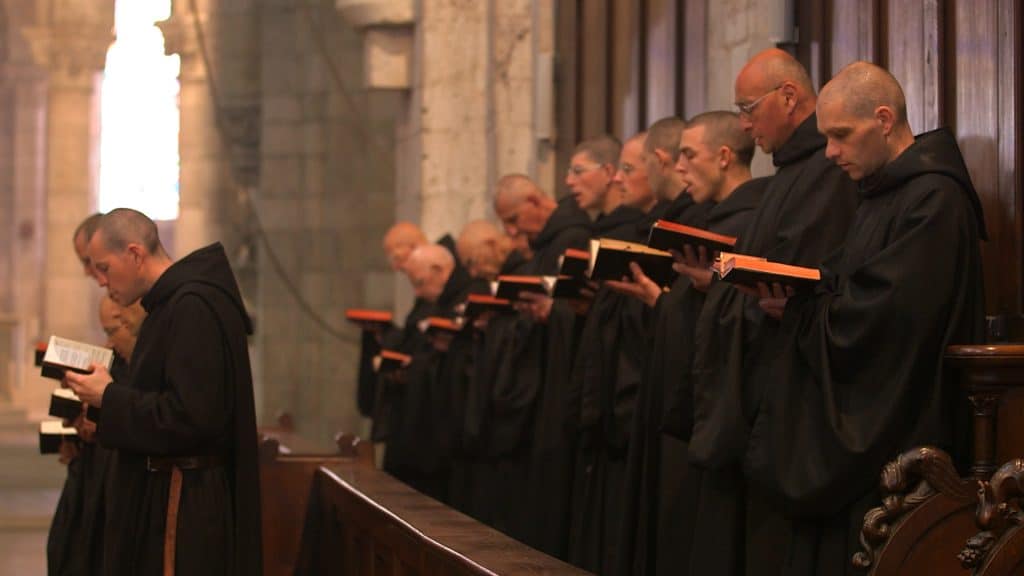
Singing is a major occupation for monks, whom the Rule of Saint Benedict calls and recalls incessantly to the choir, seven times a day and once at night. It matters little whether or not there is anyone in the nave of the church to listen to them: for the monks sing to God, and the monks sing for God.

Singing for God is as ancient as the Bible: music was part of the office of the priests and Levites of the Temple in Jerusalem, and King David poured out his heart before God while accompanying himself on the harp. The psalms have preserved musical indications for us, which have for the most part become enigmatic today.
The first Christians transposed this liturgical use of music into their respective cultures. The oldest texts testify that they gathered in the night and “sang in honor of Christ as if to a God.”

Singing to God is a purely gratuitous and nobly useless action. When the echo of the last notes of the office has finished fading away, everything becomes as it was before, as if nothing had happened. Of this demanding work, incessantly resumed, no trace remains. Musical notes do not pile up; one would not think of measuring their accumulation.
But GOD listens to them with attention and tenderness.

The Christian mystery is that of the eternal Wisdom of God come to dwell in the world she had created with order, weight, and measure, to save man from the disorder he introduced into it through his sin.
From the earliest times, the liturgy, in order to carry man beyond himself to the encounter with God, turned away from the haunting melodies and obsessive rhythms that lead to the engulfment of the spirit in the intoxication of the senses, to irrationality and excess. It chose a music built in harmony with the supreme order of the cosmos and carrying a meaning that uplifts the heart, a music that “without abolishing the senses, uplifts them, merges them with the spirit.”

This music developed according to different styles: “while in the East, Byzantine Christianity remained faithful to the tradition of monodic vocal music, in Slavic regions, undoubtedly under Western influence, monodic chant expanded into polyphony […].
In the West, traditional psalmody reached such perfection in Gregorian chant that it became the permanent model of reference for musica sacra.”
Cardinal Ratzinger, The Celebration of Faith

To modern ears, accustomed to the splendors of classical polyphony or catchy rhythms, Gregorian chant may at first seem quite austere in its bareness; and the ancient and surprising modality of its melodies, coming from a distant past, seems quite poor to occupy, throughout a lifetime, such long moments in the monk’s day.
Yet these melodies are the foundation stones of the entire musical edifice of our Western civilization.

From the first centuries, the Church had to defend itself against excesses of refinement and aestheticism, but also against a Platonic spiritualism that would have wanted to repudiate the religious use of music.
For “Christian spiritualization is not simply an opposition to the universe of the senses, as is the mysticism of Platonism, but a journey toward the Lord who is spirit (2 Cor 3:17; cf. 1 Cor 15:45); this is why the body is included in spiritualization.”
Cardinal Ratzinger, The Spirit of Music

Gregorian chant, in the simplicity of its monody, very quickly appeared as the middle way that allowed music to enrich words with what they could not say on their own, without art stifling the word, so to speak. Monasteries have kept it jealously and exclusively, so that it was always possible to return and draw from it the inspiration for Christian music over the centuries. It is from this living tradition that the prayer of monks still borrows its choral form today.

The monks of old, faced with the same difficulties, were nonetheless aware of the perfection required by divine praise, and took seriously the verse of the psalm: in conspectu Angelorum psallam tibi – in the presence of the Angels I will sing to you (Ps 138:1), considering that they had to “pray and sing to unite themselves with the music of the sublime spirits, considered as the authors of the harmony of the cosmos…”

Les anciens moines, confrontés aux mêmes difficultés, n’en étaient pas moins conscients de la perfection demandée par la louange divine, et prenaient au sérieux le verset du psaume : in conspectu Angelorum psallam tibi – en présence des Anges je te chanterai (Ps 137,1), considérant qu’ils devaient « prier et chanter pour s’unir à la musique des esprits sublimes, considérés comme les auteurs de l’harmonie du cosmos… »

“… Saint Bernard of Clairvaux uses an expression from the Platonic tradition, transmitted by Saint Augustine, to judge the poor singing of monks which, in his eyes, was by no means a secondary incident. He qualifies the cacophony of a poorly executed chant as a fall into the regio dissimilitudinis, into the ‘region of dissimilarity’ […]. He indicates here that the culture of singing is a culture of being, and that monks, through their prayers and their songs, must correspond to the greatness of the Word entrusted to them, to its imperative of real beauty.”
Benedict XVI, Address at the Collège des Bernardins, September 12, 2008

By recalling in his Rule that monks sing in the presence of God and his Angels, “Benedict certainly wanted to tell the monks that they should reflect on the fact that the Angels are silently present in the choir, that they hear, and that the singing must be such that they can listen to it.
But we also sing with them. We should thus ‘incline the ear of the heart,’ understand the singing of the Angels from within, so to speak, attune ourselves to it and sing with them. This ‘singing together’ then naturally includes the entire community of saints of all times and all places.”
Benedict XVI, address to a delegation from the Regensburg Higher School of Church Music, Castel Gandolfo, September 28, 2007.

There is only one liturgy, on earth and in heaven; and if the singing of the monks must be such that it does not disturb the harmony of that of the Angels and Saints, this formidable requirement thus has its counterpart in the fact that it is, as it were, lifted up and redeemed by them.
When hearts are truly given to God and seek his glory, the imperfections and deficiencies of the humble monastic chant here below are purified by the angelic praise into which it merges.
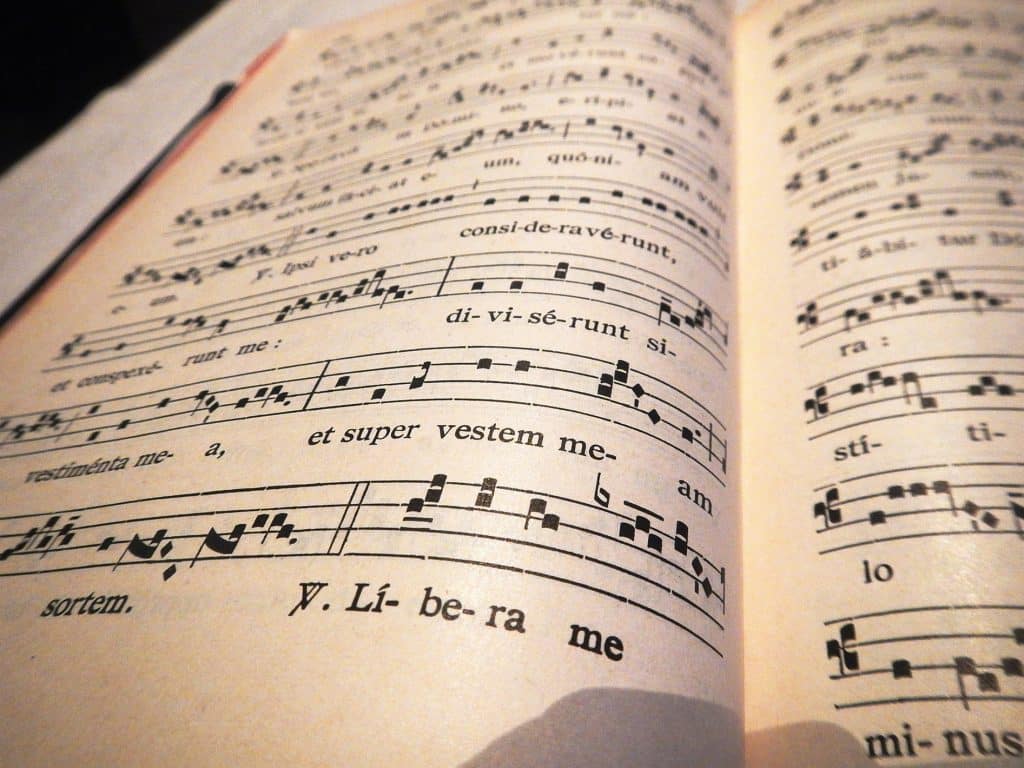
Servants of the Church’s prayer and its contemplation of the mysteries of Christ, happily overwhelmed by the beauty of what they have to sing, the monks may well take as their motto the exclamation of Saint Paulinus of Nola:
Ars nobis una fides, et musica Christus
“For us there is but one art, faith, and one music, Christ.”