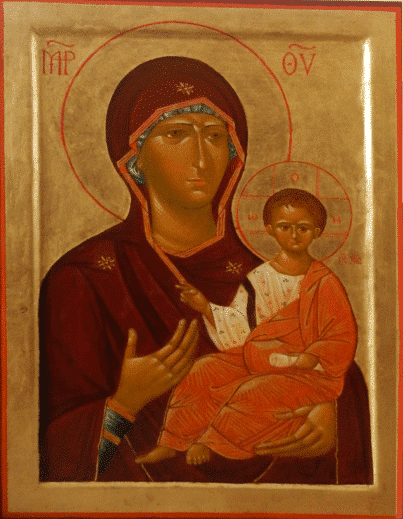
This icon is inspired by an ancient Greek icon from the 13th century, currently preserved in the icon gallery of the Church of Saint Clement of Ohrid, in Macedonia. The name for this type of icon comes from the Greek hodigos, which means ‘guide.’ The Theotokos, meaning the Mother of God, who carries the Christ Child in her right hand and points to him with the other, becomes our ‘guide’ toward Christ, the ‘Way, the Truth, and the Life’ (Jn 14:5).
The Mother of God is presented in a hieratic pose. She is clothed in the maphorion of dark purple, a symbol of her royal dignity, upon which shine three gold stars, a very ancient Syriac symbol of the triple virginity of Mary: before, during, and after childbirth. The Christ Child is represented in the fullness of his divine-humanity, for despite his child-like size, he has the features of an adult. His garment is streaked with gold rays (a technique known as ‘assist’), a symbol of his divinity. His posture is that of the merciful judge: with his right hand, he blesses, and with his left, he holds the scroll of the Gospels.
Inscribed on the gold background are the first and last letters of the Greek words METER and THEOU, meaning ‘Mother of God,’ as well as the words IESOUS and CHRISTOS, ‘Jesus Christ.’ In the nimbus surrounding the head of the Christ Child, a cross is traced whose three upper arms bear the letters of the divine Name revealed in the Old Testament: ho on, ‘He Who Is’ (Ex 3:14).
Mother of God ‘Hodegetria’
Icon measuring 34 x 45 cm, on display at Fontgombault Abbey.