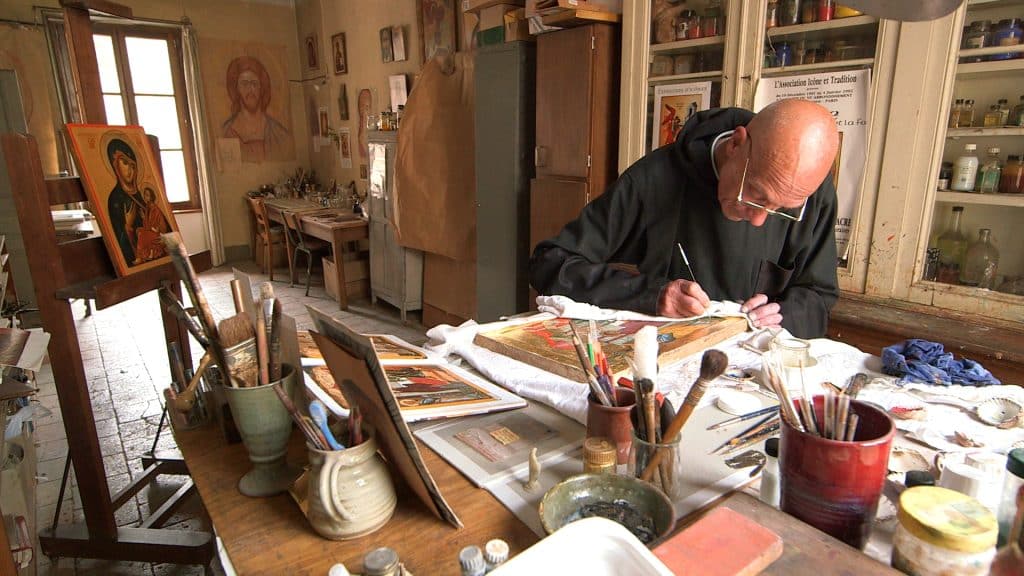
Icon painting requires a very particular technique passed down through the centuries, consisting first of a careful preparation of the support, often a wooden panel of linden or oak, poplar or beech, or even cypress, but not cedar, pine, or fir.
 The panel is first “lined” using a fine canvas (worn cotton canvas, old sheet, gauze, muslin, etc.). For this operation, the support is first coated with a thick layer of undiluted and very hot base glue (a mixture of rabbit or hare glue and hot water, prepared in a bain-marie); immediately after, the canvas, previously soaked in the glue itself, is applied. Another thick layer of glue is added on top, and it is left to dry.
 The next step is to coat this support. This traditional coating (“levkas,” from the Greek adjective leukos meaning “white”) is a mixture of glue, Meudon white or chalk, diluted in water and heated in a bain-marie, of which 12 to 15 layers are applied to the lined panel. Finally, the surface must be sanded extensively and carefully until a perfectly smooth, luminous white texture is obtained.
 The drawing requires significant preliminary work studying models, in order to fully grasp the principles of traditional iconography. Indeed, the iconographer is not given free rein to personal creativity; rather, they humbly seek to be part of a centuries-old tradition closely linked to Revelation and the faith of the Church, in order to truly be the interpreter of the invisible.
 The icon’s drawing is first made on tracing paper, in pencil; then it is transferred to the panel, and the outlines are traced over with a brush using a water-diluted color, preferably a red earth.
Then, using a dry point, these outlines of the drawing are incised. This is a simple incision into the thickness of the levkas, not a deep engraving line.
 Before applying the colors, true gold leaf must be laid over the entire background of the icon where the figures will stand out, or simply on the nimbus that surrounds their heads (hence the name “aureole”: “gold” is aurum in Latin). This is a difficult and laborious technique.
 The most traditional is called “water gilding,” which allows the gold to be “burnished” (i.e., made to shine) by rubbing it with an agate. The more recent mixtion technique is faster and easier, but it does not allow the gold to be burnished.
 The colors used for writing an icon are exclusively derived from natural pigments, of mineral or organic origin. Icon painting has employed the egg tempera technique for many centuries (at least since the 8th or 9th century): the colored pigment is mixed with an emulsion called medium resulting from a mixture of egg yolk and clear water, with a few drops of vinegar for preservation. This mixture is made with a finger, in a seashell; anything unnatural is avoided.
In Eastern Christianity, there are at least two quite different techniques for applying color to the icon’s drawing. At Fontgombault Abbey, for the flesh tones (i.e., the faces and hands of the figures), the traditional Russian technique dating back to the Middle Ages, known as “alla flaque” (puddle technique), which relies on transparency, is used.
 It is advisable to start by applying a very transparent layer of yellow ochre over the entire surface to be colored, in order to dull the white of the background. Then, the different colors are applied, each in its designated place, in very transparent layers containing a lot of medium diluted in water and little pigment, somewhat like a watercolor. The layers are superimposed, taking care that the drawing (folds of clothing, architecture, etc.) remains visible under the various layers of color; if necessary, the lines must be reinforced.
 Then we tackle the highlights of the draperies, a task that requires great skill. There are three zones where the light is increasingly intense. The last is pure white. Care must be taken to ensure that the shadow areas are transparent, and the light areas more opaque, meaning with more and more pigment.
 The painting of faces and hands comes last. This is the most difficult technique. It requires very careful execution, as the face is the noblest part of the human body, where the spirit is reflected. The entire surface of the face and hands (and possibly feet) is covered with a rather dark base color, resulting from a mixture of natural umber, yellow ochre, and a hint of red ochre. The greenish color thus obtained, called “proplasme,” is applied in large puddles of fairly liquid paint, but rich enough in pigments not to be too transparent. A second layer can be applied, but the facial features must remain slightly visible under both layers, even if they need to be retraced.
 Then we begin to apply the areas of light, always in the same precise spots, and always using the puddle technique and successive superimposed layers. This work has a profound symbolic significance: it is a symbol of our own spiritual journey, moving from the shadow of our earthly nature towards the light of the divine world. Finally, very bright strokes of light are applied with pure white on certain parts of the face, making them extremely luminous, as if illuminated from within.

When all surfaces have received their color, attention is turned to the details of the draperies, architecture, and decorative elements: plants, animals… which are part of certain scenes such as the Nativity, the Transfiguration, or the Resurrection, for example.
 When the painting work is entirely completed in all its details, the name of the Lord, the Virgin, the Saints represented, or the mystery illustrated, is inscribed, either in Slavonic, Greek, Latin, or more recently in the vernacular.
Certain abbreviations are traditional, as at the top of this icon where the first and last letters of the Greek words Mater and Theou are simply indicated on either side, meaning “Mother of God.”